AI / ML

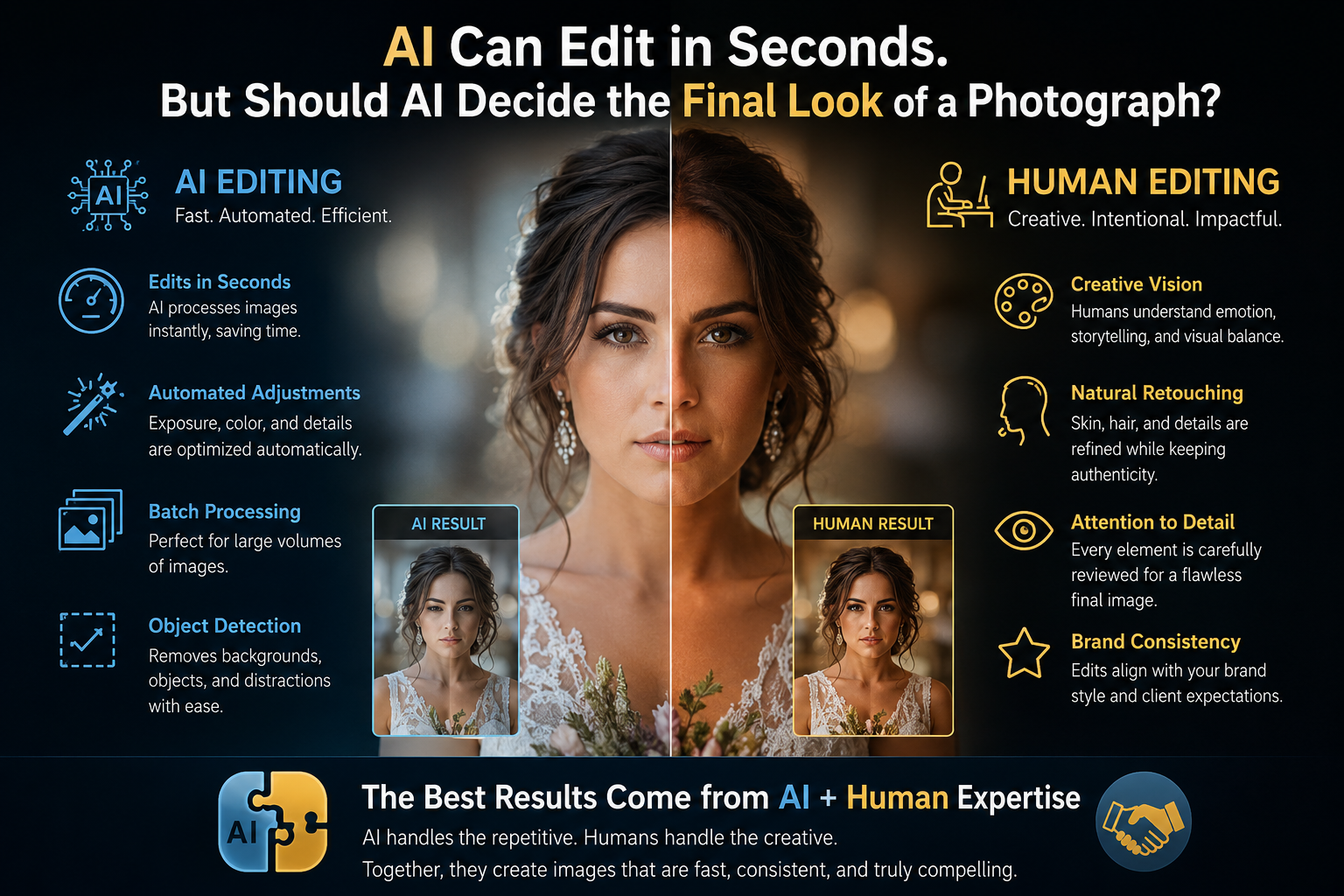
AI Can Edit in Seconds. But Should AI Decide the Final Look of a Photograph?

Discover how AI is transforming professional photo editing by automating background removal, color correction, noise reduction, and batch processing. Explore where AI delivers exceptional speed and efficiency, where human creativity remains irreplaceable, and why the best results come from combining advanced AI technology with skilled editors. Learn how this hybrid approach preserves authenticity, brand consistency, emotional storytelling, and premium image quality.

03 Aug 2026, 04:09 PM
AI Can Edit in Seconds. But Should AI Decide the Final Look of a Photograph?

AI Can Edit in Seconds. But Should AI Decide the Final Look of a Photograph?

Artificial intelligence has transformed photo editing faster than almost anyone expected. Tasks that once required hours of masking, retouching, color grading, object removal, and image enhancement can now be completed in seconds with AI-powered tools. For photographers, agencies, and businesses handling thousands of images, AI has dramatically improved efficiency but it has also raised an important question:

Should AI decide the final look of a photograph?

The answer isn't simply "yes" or "no."

While AI is exceptional at automating repetitive editing tasks, photography has never been just about technical perfection. Every image tells a story. Every adjustment influences mood, emotion, authenticity, and brand perception. Those creative decisions require experience, artistic judgment, and an understanding of the photographer's vision qualities that still belong to skilled human editors.

The future of professional photo editing isn't about choosing between AI and humans. It's about understanding where each delivers the greatest value.

How AI Changed Photo Editing Forever

The creative industry has embraced AI because it solves one of its biggest challenges: time.

Professional photographers often return from weddings, sporting events, fashion shoots, or commercial campaigns with hundreds or even thousands of images. Manually correcting every exposure, removing distractions, and preparing files for delivery can consume days of work.

AI has transformed that process.

Modern editing software can now:

Detect subjects automatically

Remove or replace backgrounds

Match colors across large image collections

Reduce image noise

Recover highlights and shadows

Upscale low-resolution photographs

Apply batch corrections to thousands of images

Recent industry studies have shown that AI-assisted editing can reduce post-processing time dramatically for high-volume photography workflows, allowing photographers and businesses to deliver projects much faster while maintaining consistency.

For industries such as e-commerce, real estate, school photography, and event photography, this translates into faster turnaround times, lower production costs, and greater operational efficiency.

There's no question that AI has become an invaluable productivity tool.

Speed Doesn't Always Equal Quality

One common misconception is that photo editing is simply about making an image "look better."

Professional editors know the goal is much deeper than that.

Great editing preserves the photographer's vision while ensuring the final image feels natural, believable, and emotionally engaging.

Imagine a wedding portrait captured during sunset.

Should the warm golden light remain untouched to preserve the atmosphere?

Should skin tones be brightened slightly for a softer, romantic appearance?

Should background distractions be removed completely, or should some elements remain to preserve the authenticity of the moment?

There isn't a universally correct answer.

The right decision depends on the photographer's style, the client's expectations, the intended audience, and the story the image is meant to tell.

AI analyzes pixels. Human editors interpret meaning.

Technical accuracy doesn't always translate into emotional impact and that's where human judgment becomes indispensable.

Where AI Excels

AI has become remarkably effective at objective, repetitive editing tasks that follow clear patterns.

Background Removal

Creating clean cutouts for product photography now takes seconds instead of minutes, making AI especially valuable for online retailers and online marketplaces.

Exposure and Color Correction

AI quickly analyzes brightness, contrast, white balance, and tonal range to produce balanced starting points for further refinement.

Noise Reduction

Modern AI algorithms remove digital noise while preserving significantly more detail than traditional methods, especially in low-light photography.

Batch Processing

When photographers return from large events with thousands of files, AI can apply consistent adjustments across an entire collection with impressive speed.

Removing Minor Distractions

Dust spots, blemishes, power lines, unwanted objects, and other small imperfections can often be corrected automatically with minimal manual effort.

For these repetitive production tasks, AI saves countless hours while improving workflow efficiency.

Where Human Editors Still Make the Difference

Despite its impressive capabilities, AI continues to struggle with subjective creative decisions.

Natural Skin Retouching

Many AI tools smooth skin aggressively, removing the texture that makes portraits look authentic.

Experienced retouchers know exactly how much refinement is enough without making subjects appear artificial.

Hair, Fur, and Fine Details

Loose hair strands, pet fur, lace, embroidery, transparent fabrics, and intricate textures remain some of the most challenging elements for automated editing.

Professional editors carefully restore these details to maintain realism.

Brand Consistency

Luxury brands, fashion retailers, real estate agencies, advertising companies, and e-commerce businesses all have unique visual identities.

While AI can optimize an image technically, it doesn't understand the subtle creative standards that define a brand's style.

Professional editors ensure every image aligns with those expectations by maintaining consistent color tones, lighting style, retouching quality, shadows, and overall visual identity across every campaign.

Understanding Client Expectations

Photography is a collaborative creative process.

A photographer may request warmer skin tones, a luxury retailer may prefer subtle shadows, or a real estate agency may want interiors to appear bright yet natural.

These creative preferences often evolve through communication, revisions, and experience something AI still cannot truly understand or replicate.

Emotional Storytelling

Photography isn't simply documentation.

It's communication.

A wedding photograph should evoke emotion.

A luxury watch advertisement should feel sophisticated.

A travel campaign should inspire curiosity.

These outcomes come from intentional creative decisions not automated presets.

A Real-World Workflow: AI Starts, Humans Finish

The most successful editing teams don't rely entirely on AI or entirely on manual editing.

Instead, they combine both.

Consider a fashion e-commerce company preparing thousands of product images for an online launch.

AI can automatically:

Remove backgrounds

Align products

Correct exposure

Standardize image dimensions

Before those images are published, experienced editors review every file to:

Preserve fabric texture

Correct color accuracy

Refine shadows

Restore hair and garment edges

Ensure consistency across the catalog

Rather than replacing skilled editors, AI allows them to spend less time on repetitive production work and more time refining the details that truly influence the final image.

This hybrid workflow delivers both speed and premium quality and it is quickly becoming the preferred approach across the creative industry.

Photography Is More Than Technology

Every photographer develops a unique visual style.

Some favor dramatic contrast.

Others prefer soft, natural lighting.

Some emphasize rich cinematic colors.

Others pursue clean, minimalist aesthetics.

These creative choices cannot be reduced to mathematical formulas.

AI generates results based on learned patterns.

Human editors make deliberate artistic decisions based on experience, intuition, communication with clients, and an understanding of visual storytelling.

That's why two professionals can edit the same photograph beautifully while producing completely different—but equally compelling—results.

Creativity isn't standardized.

It never has been.

The Future Is AI Plus Human Creativity

The discussion shouldn't be framed as AI versus human editors.

That's the wrong comparison.

AI is becoming an incredibly powerful production assistant.

Human editors remain the creative decision-makers.

The strongest workflows already combine both.

AI handles repetitive production.

Editors provide quality control.

Editors preserve authenticity.

Editors maintain brand consistency.

Editors solve complex creative challenges.

Automation increases efficiency.

Human expertise ensures excellence.

Together, they create better results than either could achieve alone.

Finding the Right Balance

Businesses that depend entirely on AI often discover subtle but important problems:

Over-smoothed portraits

Inconsistent product colors

Artificial-looking lighting

Missing textures

Generic-looking visuals

Meanwhile, businesses that combine AI with professional editing benefit from faster turnaround times while maintaining the visual quality customers expect.

That balance is becoming the new industry standard.

Final Thoughts

Artificial intelligence has permanently transformed photo editing, and that's something worth embracing. It enables photographers and businesses to work faster, automate repetitive tasks, and focus more on creativity than production.

But speed alone has never defined a great photograph.

The final image is shaped by judgment, emotion, experience, communication, and intention.

AI can enhance an image.

AI can automate a workflow.

AI can accelerate production.

But it cannot fully understand why one photograph should feel timeless, another should feel luxurious, and another should preserve the raw emotion of a once-in-a-lifetime moment.

As AI continues to evolve, the value of human creativity doesn't disappear it becomes even more important. In a world where anyone can generate technically polished images, the true competitive advantage lies in making thoughtful creative decisions that reflect a photographer's vision and a brand's identity.

Technology can perfect pixels, but only human creativity can shape emotion.

The future of professional photo editing belongs to those who combine AI's efficiency with the artistic judgment that transforms ordinary images into memorable visual stories.

Because in the end, great photography isn't defined by how quickly an image is edited.

It's defined by how powerfully it connects with the people who see it.

Talk to Image Solutions India today - 91 97381 67163

 sales@imagesolutionsindia.com

www.imagesolutionsindia.com

Get a Free Consultation →

The Human-AI Hybrid Advantage

While automated background removal models can process basic isolated shapes in milliseconds, complex apparel transparencies, loose hair textures, and fine footwear mesh panels require human expert QA oversight for precision. By combining automated batch pre-processing with expert pen-tool clipping workflows, global brands can reduce editing production timelines significantly.

Need high-precision background masking for an upcoming catalog launch? Upload your raw image files and receive your first 3 assets completely free of charge.

Get Free Sample ➜
Related Insights & Case Studies

The Future of E-commerce Product Photography in 2026

The Future of E-commerce Product Photography in 2026

Discover how AI-powered technology and professional photography are reshaping eCommerce product visuals in 2026. Explore how the hybrid approach combines human creativity, product accuracy, and advanced AI workflows to help brands create authentic, scalable, and high-converting images that enhance customer trust, improve engagement, and drive online sales.

Read Full Article

Bulk Product Photo Editing Company in India

Bulk Product Photo Editing Company in India

Professional bulk product photo editing company in India offering high-quality image editing services for eCommerce, Amazon, Shopify, Flipkart, and online retailers. Our expert team specializes in background removal, product retouching, color correction, shadow creation, image masking, ghost mannequin, and clipping path services. Get fast turnaround, affordable pricing, consistent quality, and scalable solutions to make your product photos stand out and increase online sales.

Read Full Article

The Connection Between Website Speed and User Experience

The Connection Between Website Speed and User Experience

Website speed plays a crucial role in user experience, search engine rankings, and online conversions. Faster-loading websites reduce bounce rates, improve engagement, and increase customer satisfaction. Learn how page speed optimization, Core Web Vitals, mobile performance, image optimization, caching, and efficient coding can enhance website usability, boost SEO, and drive more traffic, leads, and sales for your business.

Read Full Article