Photo Editing

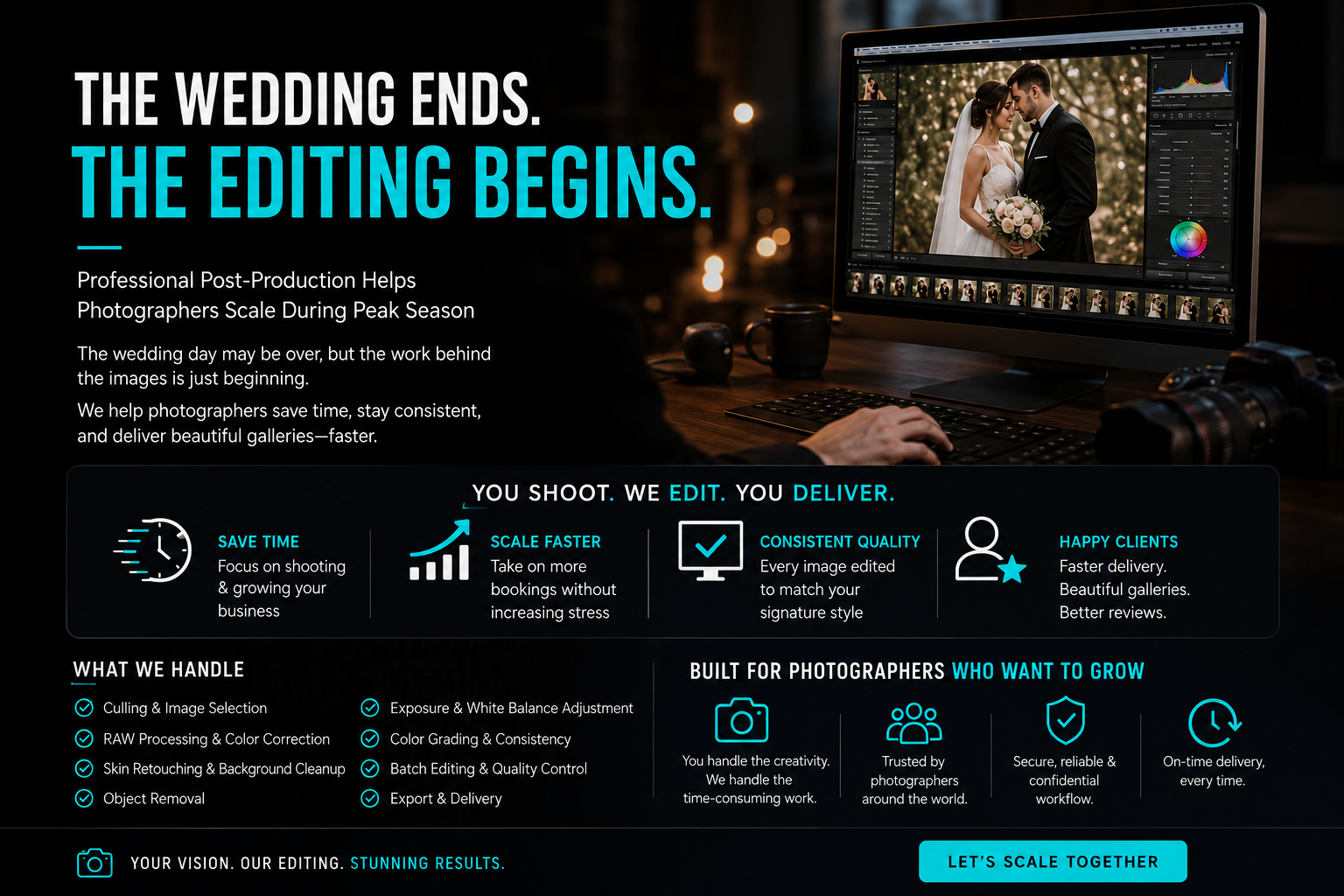
The Wedding Ends. The Editing Begins: How Professional Post-Production Helps Photographers Scale During Peak Season

Professional post-production can transform how wedding photographers manage peak season. From RAW photo editing and color correction to retouching, batch processing, and quality control, the right workflow helps photographers handle large volumes without compromising their signature style. Discover how wedding photo editing services and photo editing outsourcing can improve turnaround times, increase capacity, reduce editing backlogs, and give photographers more time to focus on clients.

17 Aug 2026, 12:04 PM
The Wedding Ends. The Editing Begins: How Professional Post-Production Helps Photographers Scale During Peak Season

The Wedding Ends. The Editing Begins: How Professional Post-Production Helps Photographers Scale During Peak Season

The wedding day may be over, but for the photographer, the job is far from finished.

The cameras are packed. The guests have gone home. The venue is empty. But sitting on a hard drive could be 2,000, 3,000, or even more RAW files waiting to be reviewed, selected, corrected, retouched, exported, and delivered.

Then comes the next wedding.

And the next one.

This is where peak wedding season can expose a problem that has little to do with photography itself: post-production capacity.

For photographers who want to grow, professional wedding photo editing services are not simply about saving a few hours. A well-designed post-production workflow can determine how many clients a studio can realistically handle, how quickly galleries can be delivered, and whether growth leads to opportunity—or burnout.

The Real Challenge Starts After the Shoot

Wedding photographers often spend most of their attention preparing for and capturing the event. Yet post-production can consume an equally significant amount of time.

A wedding with 2,000 RAW files does not mean 2,000 photographs will appear in the final gallery. But those files still have to be reviewed and managed.

The typical wedding photo editing workflow can involve:

RAW file processing

Culling and image selection

Exposure correction

White balance adjustment

Color correction

Color grading

Skin retouching

Background cleanup

Object removal

Noise reduction

Sharpening

Cropping

Batch editing

Quality control

Export and delivery

Now imagine completing several weddings in a short period.

The editing queue grows while the photographer is already preparing for the next shoot.

That is when post-production stops being a simple task and becomes a business capacity issue.

When More Bookings Create More Problems

More bookings sound like a good problem to have.

But additional bookings also create additional files, additional editing hours, additional client communication, and additional delivery deadlines.

Consider a photographer who books four weddings in two weeks.

The revenue increases.

The shooting schedule becomes busier.

But if every wedding also requires several evenings of personal editing, the photographer may simply be exchanging more bookings for longer working hours.

That is not necessarily scaling.

It is increasing workload.

True scaling requires a workflow that can handle increasing demand without requiring the photographer to personally perform every production task.

This is where photo editing outsourcing can become strategically useful.

The Difference Between Editing More and Handling More

There is an important distinction between editing more photographs and building more capacity.

If a photographer edits everything personally, capacity is limited by personal time.

There are only so many hours available after shooting, client meetings, marketing, administration, and everyday life.

Professional photo post-production services can introduce additional capacity into the workflow.

A photographer can continue to control the creative direction while an experienced editing team handles defined production tasks.

For example:

Photographer: Captures the wedding, selects images, establishes the visual style, and provides references.

Editing team: Handles agreed editing, retouching, corrections, and preparation.

Photographer: Reviews the finished work and provides final approval.

This creates a workflow where the photographer remains creatively involved without being responsible for every repetitive adjustment.

Consistency Becomes More Important as Volume Increases

Editing 100 photographs consistently is one challenge.

Editing 2,000 photographs consistently is another.

Wedding photographers work in constantly changing environments. The ceremony may be photographed indoors, portraits outdoors, the reception under artificial lighting, and the dance floor in extremely low light.

Without a structured approach, the final gallery can contain noticeable differences in exposure, white balance, skin tone, and color.

Professional wedding photography post-production can help bring those images together.

The goal is not to make every photograph identical.

The goal is to make the gallery feel visually connected.

That distinction matters.

A wedding gallery should still contain variation because lighting and moments change. But those variations should feel intentional rather than accidental.

Protecting the Photographer's Signature Look

Outsourcing editing does not have to mean outsourcing creativity.

In fact, a strong editing partnership should be built around the photographer's existing style.

A photographer may prefer:

Warm or neutral skin tones

Soft highlights

Muted greens

High or low contrast

Bright and airy exposure

Dark cinematic tones

Subtle retouching

Natural skin texture

These preferences can be documented through presets, reference images, sample galleries, and editing instructions.

The editing team then works within those guidelines.

This is particularly important for photographers with a recognizable brand. Their editing style is part of what clients are buying.

The objective of professional photo editing should therefore be consistency with the photographer—not conformity to an editor's personal style.

Retouching Should Improve the Image, Not Announce Itself

Wedding portraits are among the photographs clients care about most.

They may print them, display them at home, include them in albums, or share them across social media.

That makes photo retouching services an important part of professional post-production.

However, good retouching is rarely about making people look completely different.

Temporary skin imperfections, distractions, flyaway hairs, unwanted objects, or small background issues can be addressed while maintaining natural facial features and skin texture.

The best retouching often works quietly.

The client sees a polished photograph.

They do not necessarily see the work that created it.

AI Can Accelerate the Workflow—but Judgment Still Matters

AI is changing professional photo editing.

Modern tools can assist with culling, masking, noise reduction, object removal, skin retouching, and other repetitive processes.

For high-volume wedding photography, this can be valuable.

But speed does not automatically equal quality.

Wedding photography contains context that technical automation may not fully understand.

A close-up of a bride's expression may have greater emotional importance than technically similar images.

A particular photograph may intentionally contain atmospheric shadows.

A warm color cast may be part of the photographer's creative style rather than an error.

This is why AI-assisted photo editing works best when combined with human judgment.

AI can help accelerate repetitive processes.

Experienced editors can evaluate the results, maintain consistency, and make decisions according to the photographer's style.

Faster Delivery Is a Workflow Issue

Clients rarely see the hours behind their wedding gallery.

They simply see the final result—and how long they had to wait for it.

A photographer may have a perfectly reasonable explanation for a delay: multiple weddings, thousands of RAW files, demanding retouching, and a busy schedule.

The client, however, experiences only the waiting.

An efficient wedding photography editing workflow can help reduce that gap.

When editing capacity increases, photographers can potentially provide previews and final galleries within more predictable timeframes.

That can make the entire client journey smoother.

And in an industry driven heavily by referrals and reputation, the experience surrounding delivery matters almost as much as the photographs themselves.

Quality Control Is Essential at Higher Volume

Outsourcing only works if quality remains consistent.

A fast editing workflow that produces inconsistent images creates another problem for the photographer.

That is why professional photo editing quality control should be part of the process.

A final review can check for:

Exposure inconsistencies

Incorrect white balance

Uneven skin tones

Excessive retouching

Missed distractions

Editing artifacts

Cropping problems

Export errors

Inconsistent treatment across the gallery

This becomes increasingly important as project volume grows.

When hundreds or thousands of images move through a workflow, small inconsistencies can become much more noticeable.

What Should Photographers Outsource?

Not every photographer needs to outsource everything.

A better approach is to identify where personal creative input adds the most value.

Photographers may choose to retain:

Final image selection

Creative direction

Portfolio images

Signature artistic edits

Client-specific creative decisions

While outsourcing:

Batch color correction

RAW processing

Basic retouching

Background cleanup

Object removal

Large-volume image adjustments

Export preparation

This creates a hybrid editing workflow.

The photographer remains in control of the creative identity while the production workload becomes more manageable.

Building a Scalable Workflow Before Peak Season

The best time to fix an editing bottleneck is before it becomes one.

Before peak wedding season, photographers can establish:

Clear Editing Guidelines

Document preferred exposure, color, contrast, skin tones, and retouching levels.

Consistent File Organization

Use predictable folder structures, naming conventions, and backup procedures.

Reference Galleries

Provide completed examples that demonstrate the expected final look.

Defined Turnaround Times

Establish realistic delivery expectations for previews and final galleries.

Quality-Control Standards

Create a checklist that every completed project must pass before delivery.

Scalable Editing Support

Have a reliable professional photo editing company or editing team available before the workload becomes overwhelming.

These systems make it easier to handle increased volume without rebuilding the workflow every time the calendar gets busy.

Scaling Should Create Capacity, Not Just More Work

The ultimate goal is not to edit faster for the sake of editing faster.

It is to create room for the photographer to do more valuable work.

When post-production becomes more manageable, photographers can spend more time on:

  • New client enquiries
  • Consultations
  • Marketing
  • Social media
  • Portfolio development
  • Vendor relationships
  • Album sales
  • Creative planning
  • Higher-value photography projects

That is where the business value of professional photo editing outsourcing becomes clearer.

It is not simply a production shortcut.

It can be a way of separating the photographer's creative role from repetitive production work.

The Photographer's Time Is Part of the Business

A photographer's most valuable resource is not the camera.

It is time.

Time to photograph.

Time to build relationships.

Time to create.

Time to market the business.

Time to recover between demanding shoots.

If every increase in bookings creates an equal increase in editing hours, growth eventually reaches a limit.

A scalable wedding photo editing workflow helps move that limit.

The photographer can continue to define the vision while a structured post-production process handles the volume required to deliver it.

Conclusion

The wedding ends.

The editing begins.

And during peak season, that second stage can become one of the biggest constraints on a photographer's growth.

Large volumes of RAW files, multiple weddings, tight delivery expectations, detailed retouching, and the need for consistent visual style can quickly turn post-production into a full-time workload.

Professional wedding photo editing services can help photographers approach that challenge differently.

With the right combination of experienced editors, AI-assisted tools, clear creative guidelines, and quality control, photographers can build a post-production workflow that is capable of handling greater volume without sacrificing their signature style.

The real advantage is not simply getting photographs edited faster.

It is creating capacity.

Capacity to take on more clients.

Capacity to deliver consistently.

Capacity to spend less time behind the editing desk.

And, most importantly, capacity to keep doing the work that made the photographer successful in the first place capturing the moments that cannot be recreated.
 

Talk to Image Solutions India today.

📞 +91 97381 67163

📧 sales@imagesolutionsindia.com

🌐 www.imagesolutionsindia.com

Get a Free Consultation →


The Human-AI Hybrid Advantage

While automated background removal models can process basic isolated shapes in milliseconds, complex apparel transparencies, loose hair textures, and fine footwear mesh panels require human expert QA oversight for precision. By combining automated batch pre-processing with expert pen-tool clipping workflows, global brands can reduce editing production timelines significantly.

Need high-precision background masking for an upcoming catalog launch? Upload your raw image files and receive your first 3 assets completely free of charge.

Get Free Sample ➜
Related Insights & Case Studies

What Makes a Photo Look Expensive?

What Makes a Photo Look Expensive?

Discover what makes a photo look expensive from lighting and composition to color correction, retouching, perspective, and professional photo editing.

Read Full Article

How Photographers Can Deliver Wedding Galleries Faster Without Sacrificing Quality

How Photographers Can Deliver Wedding Galleries Faster Without Sacrificing Quality

For wedding photographers, the job doesn't end when the last photograph is captured. After the wedding day comes one of the most time-consuming parts of the business: sorting, editing, retouching, exporting, and delivering hundreds or even thousands of photographs. Clients naturally want to see their wedding memories as soon as possible. At the same time, photographers cannot afford to rush the editing process and compromise the consistency or quality of their work.

Read Full Article

AI Can Edit in Seconds. But Should AI Decide the Final Look of a Photograph?

AI Can Edit in Seconds. But Should AI Decide the Final Look of a Photograph?

Discover how AI is transforming professional photo editing by automating background removal, color correction, noise reduction, and batch processing. Explore where AI delivers exceptional speed and efficiency, where human creativity remains irreplaceable, and why the best results come from combining advanced AI technology with skilled editors. Learn how this hybrid approach preserves authenticity, brand consistency, emotional storytelling, and premium image quality.

Read Full Article